
Let's talk about Horace Mann
And the single biggest shift in the history of U.S. education

Last week we walked through the education ideas of three American Founding Fathers: George Washington, Thomas Jefferson, and Benjamin Franklin. They agreed with their nation-building contemporaries that educated citizens would be crucial to the continued success of the Republic. They also saw the benefits to individuals that can be achieved through learning in all its forms: letters, numbers, morals, civics, sciences, and vocational skills.
The Founding Fathers’ emphasis on widespread education took root. When Alexis de Tocqueville visited in the 1830’s, he noticed that literacy, science, and a basic understanding of government were surprisingly widespread.
But of course he was only seeing a subset of the population. At the time, more than two million individuals (15% of the total population of the country) were enslaved. Girls were generally not educated. Immigrants and other poor classes could not access quality education.
Enter the “Common Schools” movement, which “aimed to establish free, universal schooling for all children, regardless of social class.” Led by Massachusetts educator and statesman Horace Mann, the Common Schools idea captured the energy and imagination of several generations. Thinking of basic literacy as a public good, offering a basic education for free to all children? This was a radical idea in the history of the world. No one had ever tried it before. It took the American experiment to a bold new level, extending human dignity to the poor and rich alike. When I was discussing this with ChatGPT, it said, “If Jefferson planted the philosophy, Mann built the early system.”
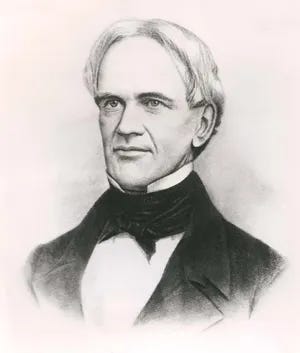
I like that framing. The Enlightenment thinkers were bold. The American Founders took their ideas seriously, refined them, and used them to justify a revolution and form a new nation. Not too long after that, Horace Mann and his colleagues implemented a structure around the core ideas.
It’s like what happened in electromagnetism. James Clerk Maxwell published four equations that describe the rules of electric and magnetic fields. Only 15 years later, Thomas Edison patented the light bulb, powered by these very concepts.
What did Horace Mann believe?
Sometimes, Horace Mann gets a bad rap nowadays. Education reformers and innovators like to point out the limitations in his model and blame him for poor outcomes. But he was designing in the 1840’s, nearly 200 years ago! It was a very different world.
I thought it might be helpful to read his words to get a better picture of Horace Mann, the man, and his views on education. For a text, I’m using Mann’s Twelfth Annual Report, provided to the Massachusetts State Board of Education in 1848.
I was surprised to find that I share many of his perspectives, even after all these years.
Optimism about human potential
Under the Providence of God, our means of education are the grand machinery by which the “raw material” of human nature can be worked up into inventors and discoverers, into skilled artisans and scientific farmers, into scholars and jurists, into the founders of benevolent institutions, and the great expounders of ethical and theological science. By means of early education, these embryos of talent may be quickened, which will solve the difficult problems of political and economical law; and by them, too, the genius may be kindled which will blaze forth in the Poets of Humanity.
Yep. This. Sometimes people ask me about Prenda’s two-word mission statement—empower learners. It’s deceptively concise. Embedded in these words are two humongous ideas.
First, that humans are capable of an elevated mode of existence, where learning is a way of life. We’ve always been learners, sharing best practices, copying each other, publishing our thoughts, replicating experiments and disproving hypotheses. But the comforts of modern life make it possible to survive without learning, and that’s a shame because the upside has never been greater. All of us have the option of standing on the shoulders of giants. Social and scientific progress has allowed an acceleration of human learning in ways Horace Mann could not even imagine. Today, in a world where information is abundant and mostly free and barriers to action are generally lower than ever in our history, the limitations to learning are mostly psychological. Adopting an identity as a learner requires courage and persistence; it’s a leap of faith we need help making.
But if we do make the leap, determining to become devoted, lifelong learners, then we will discover power. That’s the other word in the mission statement. Our human “raw material” can be cultivated and unleashed toward a variety of ends, leading to powerful impacts for the individual and for society at large.
Big picture thinking
Without undervaluing any other human agency, it may be safely affirmed that the Common School, improved and energized, as it can easily be, may become the most effective and benignant of all the forces of civilization.
Horace Mann designed Common Schools with the goal of tapping into the enormous potential of human beings who become learners. He may have underestimated the difficulty of “improving and energizing” school and forgotten the warning from Plutarch that the mind is not a vessel to be filled. As a result, the system was never designed to light fires.
But even so, he saw the long term potential of educating all humans. Putting the power of literacy, numeracy, and basic civics into their hands, Mann believed the institution he designed could contribute to the species in unprecedented ways. I believe the institution of American public school has had huge positive impact.
Like, really big picture
When its faculties shall be fully developed, when it shall be trained to wield its mighty energies for the protection of society against the giant vices which now invade and torment it;--against intemperance, avarice, war, slavery, bigotry, the woes of want and the wickedness of waste,--then, there will not be a height to which these enemies of the race can escape, which it will not scale, nor a Titan among them all, whom it will not slay.
Not only can education elevate individuals and better society, but Mann claims it has the power to topple all of our problems. It’s a bold, audacious position. I think he’s right.
Education as the great equalizer
Education, then, beyond all other devices of human origin, is the great equalizer of the conditions of men – the balance-wheel of the social machinery
This may be Horace Mann’s punchiest and most memorable wisdom, that education is perfectly suited to counteract the unfairness and oppression that are core to the human condition.
This idea resonates deeply with me. During a summer living in Mozambique I grappled with the injustice of a world where I was born with everything and so many great people were born with nothing. I didn’t resolve the crisis, but I decided it was only right that I spend my time and energy and resources trying to help others and contribute to the world. I realized that inviting humans to become learners is a great way to open doors. I don’t have the resources to give everyone money or food, but if I can bring pathways for learning, then perhaps it will make a difference.
Learning as a human right for all
To have created such beings as we are, and to have placed them in this world, without the light of the sun, would be no more cruel than for a government to suffer its laboring classes to grow up without knowledge...
It’s a longer metaphor, but Mann is essentially arguing for the inherent morality of offering education to all economic classes. If kids can learn the basics, they can enter into advanced society, not only to benefit from progress, but to contribute to it.
Abundance mindset and value creation
Beyond the power of diffusing old wealth, it has the prerogative of creating new. It is a thousand times more lucrative than fraud; and adds a thousandfold more to a nation’s resources than the most successful conquests. Knaves and robbers can obtain only what was before possessed by others. But education creates or develops new treasures,--treasures not before possessed or dreamed of by any one.
Sometimes we think in “zero sum” terms; if you have more, then I have less, and vice versa. Thankfully, human power doesn’t work that way. Doing the work to become a learner will help you now, help you later, and help everyone in your path. It’s creation ex nihilo. Think of the ways we all benefit because someone learned how to make fire, discovered DNA, invented electricity.
An Important Moment
Within a ten year span, Horace Mann convinced decision-makers in Massachusetts to invest heavily in Common Schools for all kids (actually just white boys). He partnered with Catherine Beecher to set up teacher colleges, where the profession became predominantly female. He traveled to Prussia in 1843, collecting ideas like age-based cohorts, class periods marked by ringing bells, lectures, and textbooks. He shared his beliefs with others, who took the Common School model to their own states.
After Horace Mann, American education looked significantly different than it did before, and startlingly similar to our system today. I’ll save my critiques of Horace Mann for another post. But it’s undeniable that he had a major impact. I’d say it was the biggest inflection point in the history of education.